18 Nov 2016

Afforestation and Reforestation: Barking up the wrong tree?


Reforestation (replanting trees in deforested areas) and afforestation (planting trees in previously non-forested areas) does not sound like anything new. I’m sure your familiar with the ‘3 tree promise’ that has heavily featured as part of toilet paper adverts in the past. However, what makes reforestation and afforestation a geoengineering method is the scale and intent to remove carbon from the atmosphere.

https://blogger.googleusercontent.com/img/b/R29vZ2xl/AVvXsEit9Y5SmJu-fHXLen3g5iME92DjKzBuCLgdzqCmV78F1qRGFxr7gXz0PADWr06KAZ6S2B0RI22EUV1m-rd2NhyphenhyphenQ-De1q44I6dSKdaITlCxahinOT6nWAVwPK3emfwKDrZSrF61qSbKbFlg/s640/3+tree.png
The 3 tree promise (Velvet, 2016)

How many trees?
It is widely agreed that net-zero carbon emissions will have to be reached to meet the 2oC or 1.5 oC target by 2100. In terms of personal carbon emissions, there’s a handy online calculator. This works out a rough estimate of the number of trees required to offset your personal carbon emissions, based on your lifestyle. Even with my vegetarian student lifestyle, I got 3.5 trees….per month. How do you compare?  
https://blogger.googleusercontent.com/img/b/R29vZ2xl/AVvXsEjwU7FiG2nZdzhFO8t6gTxD6Yq1nhEp2Ieq6QXz9COgFUZQw9Zbs8Y_mmMc6U78Z6_T33V4JX4CJProkCsN04EdHp-ElV5sE0ReLqdXQGKzCEJboww6oqY7bW6v6IWxiEC3tdpFfIw3r8Y/s1600/My+emissions.png
My results for my personal emissions. Check yours at Carbonify!
Assuming there’s around 7.46 billion people, with my lifestyle we would need to plant 26.11 billion trees each month. Putting this into context, with 390 billion trees in the Amazon Rainforest, we would have to plant the equivalent of the Amazon every 15 months to offset carbon emissions, if everyone lived as I do.  
Other issues?

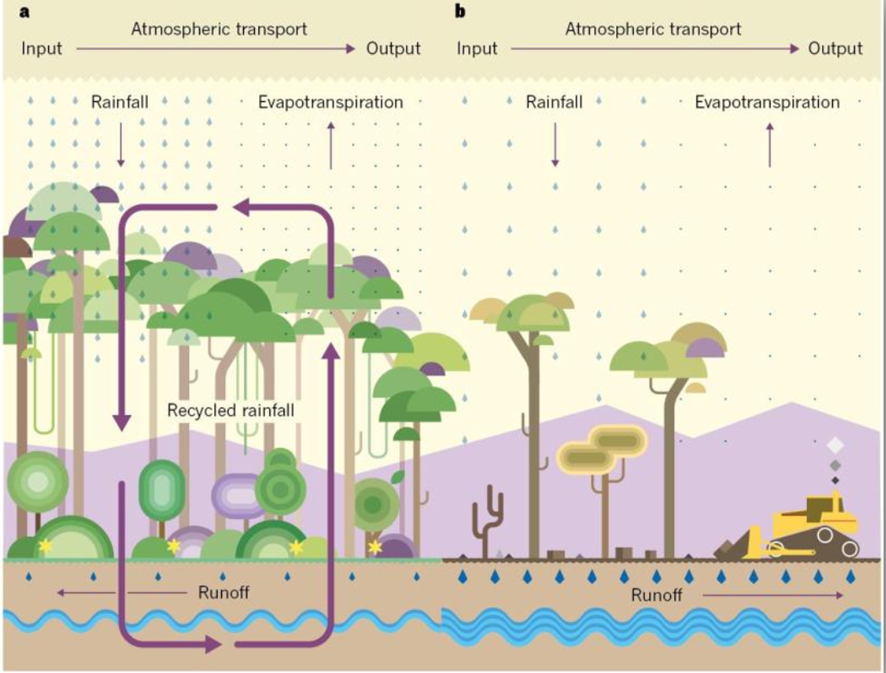
Aside from the huge amount of trees required, initially the idea of planting trees is pretty straightforward. Particularly as it is fairly easy to quantify and allows us to ‘offset’ our actions. However, Abiodan et al. (2012) modelled impacts of large-scale afforestation in Nigeria, finding there would be more rainfall in afforested areas and less rainfall in non-afforested areas, along with increased extreme events such as droughts. Not only in Nigeria, but also in the surrounding countries. This is due to changes in evapotranspiration affecting local climates, as in the diagram below. Similarly, Dickinson et al. (2013) found afforestation led to net warming in dry regions of China, where the lower albedo and changes in the heat and radiation transport cause local warming.
https://blogger.googleusercontent.com/img/b/R29vZ2xl/AVvXsEjjloGhG1Sw4DdCmWGuqihn39rNxWOFwzvMvCA4MyMX59gM0HPFmEU6AA0YyX5l2VIEoiR8G53U9d52jbW-RvAwaoI-FjWyskZto6y4UPEo1DPzenwTCpL57Jg8HptJnCtQ3kSY1XY5bEc/s640/Evapo.png
Impacts of the forest on rainfall. The forest increases 'recycled rain' through evapotranspiration, because the trees transfer water from the soil to the atmosphere. Increasing rainfall in forested areas influences the wider climate system, leading to decreases elsewhere (Aragao, 2012)

Personally, I don’t think trees are the answer to meeting the climate targets. I’m certainly not against replacing trees we’ve already cut down, and there are plenty of those, but as a long term solution I feel the impacts won’t be large enough.


11 Nov 2016

Bio-char: Learning from our ancestors?


Sticking with the theme of biomass based geoengineering techniques, next on the list is bio-char. Essentially, bio-char is charcoal that is applied to land. It is made by decomposing biomass at high temperatures in oxygen-deprived conditions (pyrolysis). The bio-char is then mixed with soil to act as a fertiliser and increase the productivity of land, replicating techniques of ancient civilisations. This removes carbon dioxide from the atmosphere through photosynthesis and stores the carbon in the soil which remains there for hundreds or thousands of years. The video below demonstrates this process.


Woolfe et al. (2010) calculated 12% of current anthropogenic emissions could be offset using bio-char without negatively impacting agriculture, biodiversity or food production. This is because crop residues and invasive plants can be used rather than converting large areas of land to purposely grow biomass. Energy production can also be added into the pyrolysis stage. If the carbon dioxide is captured and stored, as it is with BECCS, it provides another carbon negative energy source. The diagram shows the positive impacts of bio-char through the production process.

Positive impacts of biomass production (Downie et al., 2012)


Although it also uses biomass, the issues raised are surprisingly different to those with BECCS, because it doesn’t necessarily require purpose grown biomass. Ennis et al. (2012) investigate the specific impacts of bio-char on soil microbiology. They identify the long lifetime of biochar in soils could have negative side effects if it is not implemented properly because any issues would be long-lasting. Furthermore, Williamson (2016) highlight the issue of albedo. The darker colour of charcoal will lower the albedo of soil, increasing the absorption of heat. If this is applied to a significant proportion of the land’s soil this could have an overall warming effect. However, with a proper evaluation of the proposed sites the likelihood of these issues could be reduced. 


Personally, the idea of bio-char appeals much more to me than BECCS. It is a low-tech process, previously used by ancient civilisations that is unlikely to have a large impact on global food, economy or biodiversity if it is implemented in the right areas.